
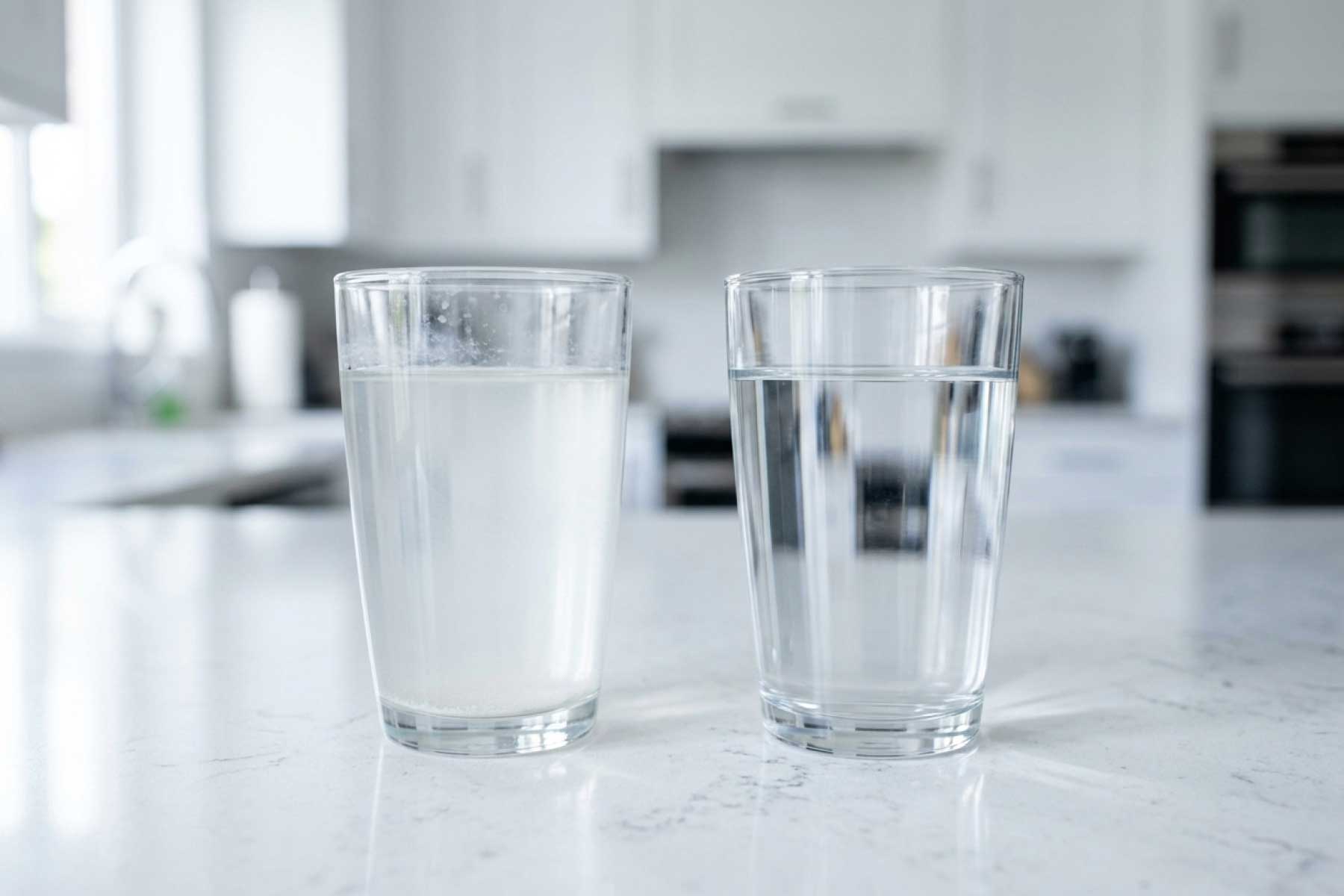

White spots on freshly washed glasses, a crusty ring around the faucet, tiny white flakes floating in a glass of water: these are some of the most common complaints in homes with calcium in water. Most households treat them as a cleaning problem. They scrub, buy descaling sprays and repeat the routine a month later. Meanwhile the same minerals keep collecting inside pipes and the water heater, out of sight until efficiency drops or the tank fails early. Getting rid of calcium in water means treating it before it reaches the faucet, and the right approach starts with understanding where it comes from and how much is there.
Is There Calcium in Tap Water?
Yes. As water moves through rock and soil, it dissolves minerals like limestone, picking up calcium along the way. Calcium and magnesium in water are the two minerals responsible for what is known as hard water. Calcium in tap water usually passes straight through to the home, because most municipal water treatment focuses on disinfection and safety, not hardness.
Calcium in well water is often higher, since the water comes directly from the ground with no treatment at all. Wells that carry calcium can also contain iron or manganese, which is why well water treatment typically starts with a full test.
Signs of Calcium Buildup in Water
Calcium deposits in water show up in a few predictable places. Chalky white scale forms on faucets, showerheads and glass shower doors. Dishes come out of the dishwasher spotted, soap and shampoo struggle to lather, and skin and hair can feel dry after a shower.
Calcium white flakes in water are another common sign. Those flakes are usually scale that formed inside the water heater or pipes and broke loose, which means calcium build up in water is already happening in places no one can see.
Calcium Buildup in Water Heaters
The water heater takes more of the damage than any other appliance. Heating water causes calcium to separate out and settle at the bottom of the tank, where it forms a hard layer between the burner and the water. Calcium buildup in a water heater reduces heating efficiency and shortens the life of the unit.
Flushing the tank helps temporarily, but it only removes what has already settled. The most reliable way to prevent calcium buildup in a water heater is to treat the water before it ever enters the tank, so calcium in the water heater never has the chance to build up in the first place.
Is Calcium in Water Bad for You?
 Calcium is an essential nutrient, and calcium in drinking water is not considered a health hazard. The EPA does not set an enforceable limit for calcium in drinking water. Too much calcium in water side effects are mostly felt in the home: scale on fixtures, worn-out appliances, dry skin and dull hair. Anyone with a specific health condition who has questions about too much calcium in water should talk with their doctor.
What Is a Safe Level of Calcium in Drinking Water?
Since there is no federal health standard, hardness levels are the usual benchmark. The U.S. Geological Survey classifies water by its calcium carbonate content:
- Soft: 0 to 60 mg/L
- Moderately hard: 61 to 120 mg/L
- Hard: 121 to 180 mg/L
- Very hard: Above 180 mg/L
Water in the hard or very hard range is where scale and appliance damage become noticeable.
How to Test for Calcium in Water
Home test strips give a rough idea of hardness, but they won’t show what else is in the water. A professional water test measures hardness in grains per gallon or mg/L, along with iron, pH and other factors that affect which system will work best. Metro Water Filter of the South offers a free in-home water test, so homeowners know exactly what they’re dealing with before choosing equipment.
Choosing a Water Filter for Calcium
The right filter for calcium in water depends on whether the goal is protecting the whole house or improving drinking water.
Conditioning Filters for Whole-House Protection
Conditioning filters soften hard water, which reduces buildup in appliances, pipes and fixtures throughout the home. Installed where water enters the house, a home water filter built around conditioning protects the water heater, dishwasher and washing machine along with every faucet and showerhead.
Reverse Osmosis for Drinking Water
A reverse osmosis filter for calcium pushes water through a semipermeable membrane that removes dissolved minerals along with other contaminants. Most homes install RO as an under sink filter for drinking and cooking water, often paired with whole-house conditioning.
Calcium Treatment for Businesses
Restaurants, hotels and manufacturers that run water-heavy equipment deal with the same scale problems on a larger scale. A properly sized commercial water filter protects that equipment and cuts down on repair and replacement costs.
Stop Calcium Buildup Before It Reaches Your Appliances
Every month untreated hard water runs through a home, more scale settles inside the water heater and pipes. Metro Water Filter of the South has helped Georgia homeowners and businesses solve hard water problems since 1972, and our in-house team will test your water and recommend a system sized to your home. Reach out to our water filtration experts to schedule your free in-home water test.